The horse roster
Your whole stable of horses in one list — status, workload, history, and settings a click away.
ForAdministratorerInstruktører
På denne siden
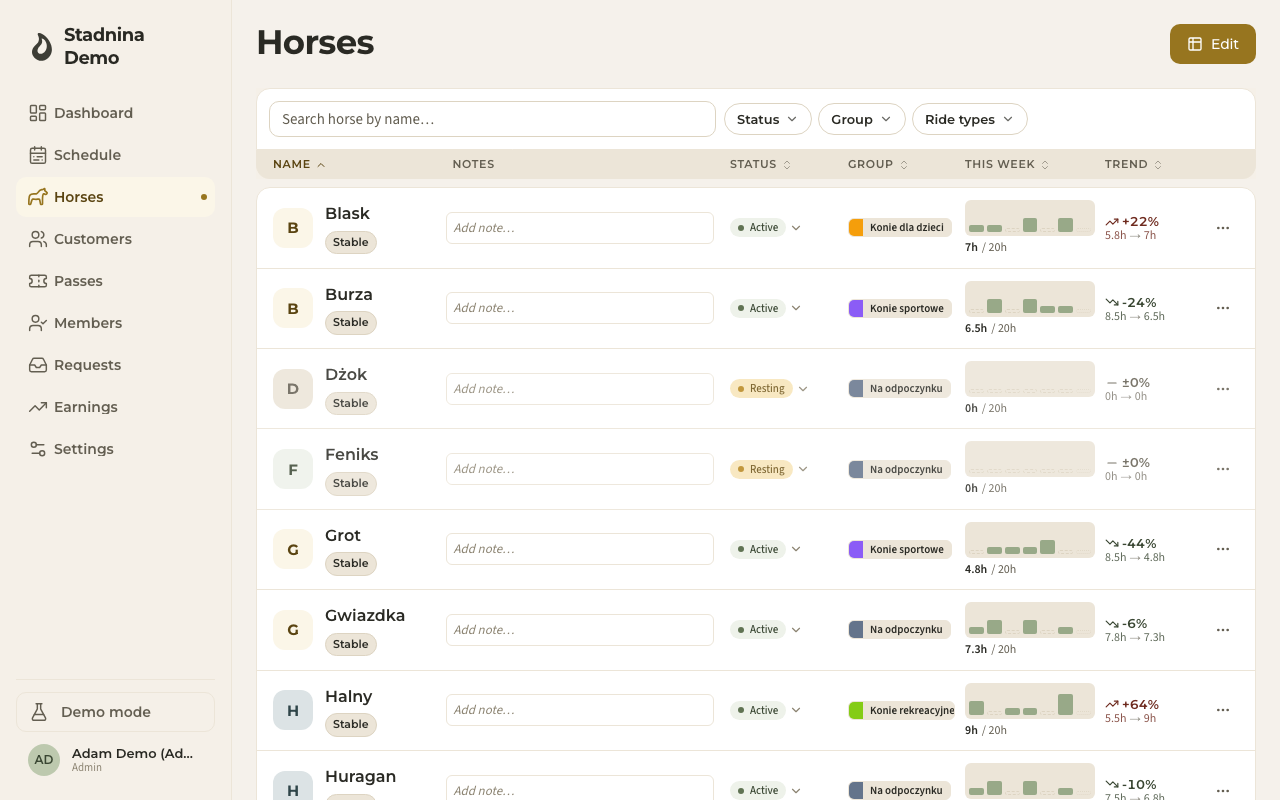
The Horses page is your stable's roster — every horse in one list, with its status, workload, and history a click away. Admins and instructors can open it; it stays hidden from riders.
Finding a horse
- Search by name in the box at the top.
- Filter by Status, Group, or Ride type using the dropdowns next to the search box.
- Sort any column — name, status, group, this week, or trend — by clicking its header.
Reading the list
Each row tells you, at a glance:
- Status — Active, Resting, and so on. Change it right in the row from the status dropdown.
- Group — the horse's colour-coded group (for example sport horses or children's horses).
- This week — how much the horse has worked this week against its weekly target, shown as a small bar.
- Trend — whether its workload is rising or falling compared with last week.
- Notes — a short note you can type straight into the row.
The horse panel
Click a horse to open its panel on the right, with three tabs:
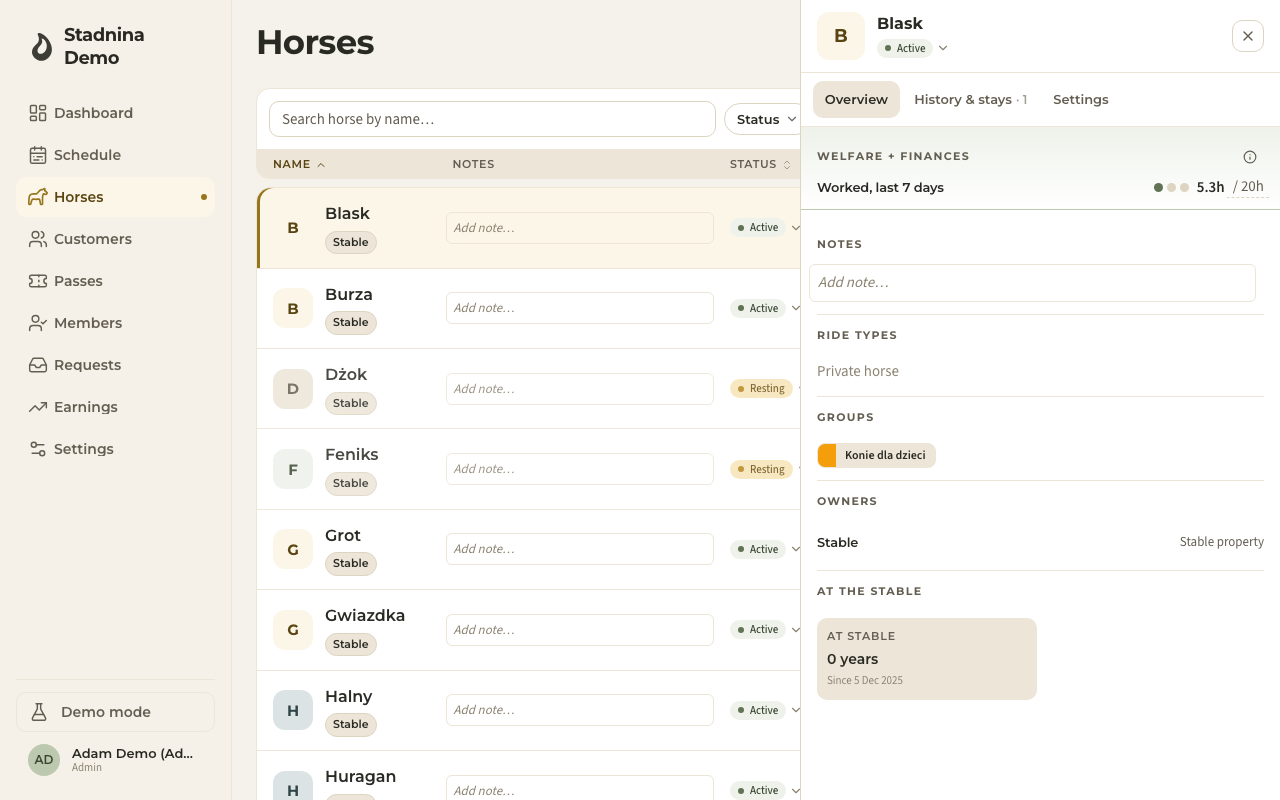
- Overview — welfare and finances at a glance: workload this week, hours worked over the last seven days, this month's revenue, flags, notes, and the ride types the horse is used for.
- History & stays — a timeline of the horse's status changes and stays: when it joined the stable, rest periods, sick leave, each with an optional note. Add, edit, or end an entry here.
- Settings — the horse's details: name, dates, owners, lease, ride-type affinity, groups, and the archive option. Admins manage everything; instructors handle the day-to-day.
Flags and notes — two fields, two audiences
A horse carries two kinds of free text, and they are not interchangeable. What separates them is who reads them.
Flags are the rider-facing one. Add and clear them under Flags in the horse's Overview tab. A flag has a severity, an author, a start date and an optional end date, and any admin or instructor can switch it off once it stops applying — so a flag nobody can resolve doesn't sit on the schedule forever.
Notes are internal. They are the Notes column in the list and the Notes field in the panel. A note has no date and nothing to clear: it is a durable fact about the horse, not an event.
| Staff & helpers | The horse's owners | Riders assigned to that horse | Anyone else | |
|---|---|---|---|---|
| Flags | see them | see them | see them | no |
| Notes | see them | see them | never | no |
- A rider counts as assigned when they hold a place on one of your rides with that horse. They see its flags on their own schedule and in that ride's details — nowhere else, and never the horse's notes.
- Severity is loudness, not privacy. Attention shows boldly on the schedule; Info waits behind the small icon. The same people read both.
- Good flags: "Riders 150–165 cm, 40–60 kg", "Pony for children up to 20 kg", "No jumping this week — farrier on Friday".
- Good notes: a microchip number, "privately owned — do not lend out", paperwork and other stable business.
Editing several horses at once
Use Edit in the top-right corner to switch the roster into a spreadsheet-style mode, change several horses quickly, and save them together.
Good to know
- Weekly workload targets drive the "This week" bar and the trend arrow. Set a horse's target in its Settings tab.
- A horse that is Resting or otherwise unavailable is left out of ride assignment automatically, so you can't book it by mistake.
- Owners are people in your Customers list — a horse can have one or several, each with a share.
Related
- Customers — where a horse's owners live.